
What Is AI in Real Estate?
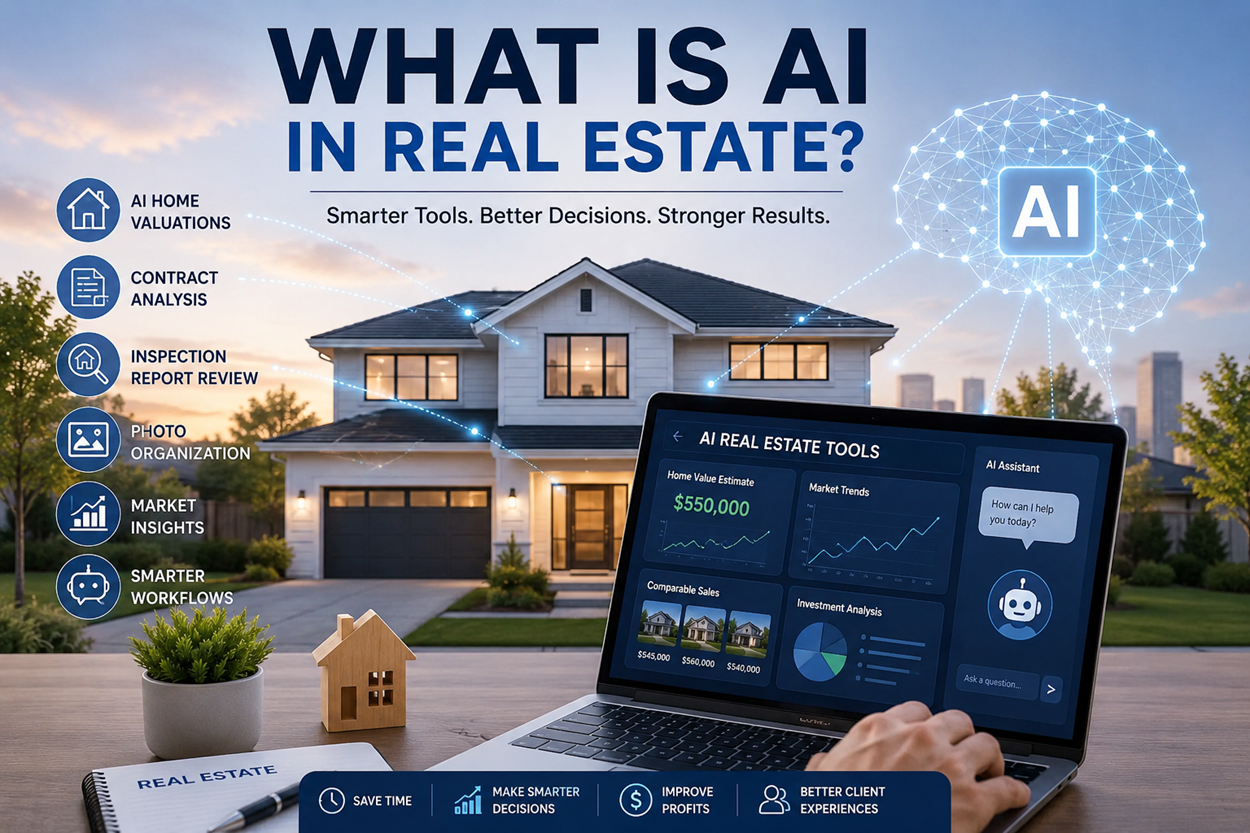
Artificial intelligence (AI) in real estate refers to the use of software that analyzes real estate data, recognizes patterns, automates repetitive tasks, and assists buyers, sellers, investors, and real estate professionals in making more informed decisions. AI is transforming nearly every stage of the real estate process, from property valuations and contract analysis to listing creation, document review, market research, customer support, and transaction workflows.
🤖 How AI Is Transforming Real Estate
Artificial intelligence is rapidly transforming how properties are researched, marketed, bought, sold, and managed. Instead of manually reviewing large amounts of information, AI can process thousands of data points in seconds to identify patterns, summarize information, automate repetitive tasks, and provide decision support.
Modern AI platforms help buyers, sellers, investors, agents, brokers, and real estate professionals work more efficiently by automating routine tasks, organizing information, delivering faster insights, and simplifying many aspects of the real estate transaction process.
🏡 How AI Works in Real Estate
Artificial intelligence analyzes large amounts of real estate data to recognize patterns, answer questions, generate recommendations, and automate routine tasks. Instead of reviewing information manually, AI can evaluate multiple data sources within seconds to help users make more informed decisions.
- MLS listing data
- Property characteristics
- Recent comparable home sales
- Active listings and local market inventory
- Neighborhood statistics and market trends
- Public property records
- User prompts and uploaded documents
- Pricing history and other available real estate data
By combining these sources, AI can help estimate property values, analyze contracts and inspection reports, organize listing photos, generate marketing content, summarize documents, answer real estate questions, and support buyers, sellers, investors, and real estate professionals throughout the transaction process.
⚙️ Common AI Applications in Real Estate
Artificial intelligence now supports nearly every phase of buying, selling, and managing real estate. From helping homeowners estimate property values to analyzing contracts and generating listing descriptions, AI-powered tools are improving efficiency throughout the transaction process. Some of the most common applications include:
- AI Home Valuations
- AI Contract Analysis
- AI Inspection Report Analysis
- AI Photo Organization
- AI Home Valuation
- AI-powered buyer and seller assistants
- Property research
- Investment analysis
- Market forecasting
- Customer support automation
- Workflow automation and transaction management
💬 Generative AI in Real Estate
Generative AI uses natural language to create written content, summarize documents, answer questions, and assist with real estate workflows. Instead of manually researching information across multiple websites or documents, users can interact with AI conversationally to receive explanations, recommendations, summaries, and personalized responses within seconds.
In real estate, generative AI is commonly used to create listing descriptions, explain contracts and inspection reports, answer buyer and seller questions, organize property photos, summarize market information, and help consumers and real estate professionals better understand complex real estate concepts.
📈 Benefits of AI in Real Estate
- Automates repetitive work.
- Analyzes market data quickly.
- Provides faster pricing research.
- Improves productivity.
- Helps reduce manual errors.
- Available 24 hours a day.
- Supports better-informed decisions.
- Saves time for buyers, sellers, and real estate professionals.
⚖️ AI vs Traditional Real Estate Workflows
Traditional real estate transactions often rely on manual research, paperwork, emails, phone calls, and repetitive administrative tasks. Artificial intelligence helps streamline many of these activities by organizing information, analyzing documents, generating reports, answering questions, and automating routine workflows.
Rather than replacing people involved in the real estate process, AI is designed to enhance productivity by providing faster access to information and reducing repetitive work. Buyers, sellers, investors, agents, brokers, and other real estate professionals can then focus more on strategy, negotiation, client relationships, and the decisions that benefit from human experience and professional judgment.
🚀 The Future of AI in Real Estate
Artificial intelligence continues to evolve rapidly across the real estate industry. Future AI platforms are expected to combine property research, home valuations, document analysis, workflow automation, customer communication, market insights, and transaction management into increasingly intelligent and connected systems.
As adoption continues to grow, AI is expected to become an everyday tool for homeowners, buyers, sellers, investors, agents, brokers, and other real estate professionals. While human expertise and professional judgment will remain essential, AI will continue to improve efficiency, simplify complex tasks, and provide faster access to information across nearly every aspect of the real estate industry.
❓ Frequently Asked Questions
What is AI in real estate?
AI in real estate refers to the use of artificial intelligence to analyze data, automate workflows, generate content, and assist buyers, sellers, investors, and real estate professionals throughout the real estate transaction process.
How is AI used in real estate?
AI is commonly used for home valuations, contract analysis, inspection reports, listing descriptions, customer support, market research, investment analysis, and workflow automation.
What are the benefits of AI in real estate?
Artificial intelligence helps automate repetitive tasks, analyze large amounts of market data, improve efficiency, provide faster insights, and support more informed decision-making for buyers, sellers, investors, and real estate professionals.
Can AI estimate a home's value?
Yes. AI valuation tools analyze comparable sales, property features, neighborhood trends, and current market conditions to estimate a home's market value. These estimates are intended to support decision-making rather than replace a formal appraisal.
Will AI replace real estate agents?
No. AI automates many repetitive tasks, but real estate professionals continue to provide negotiation, local market expertise, strategic guidance, and services that require human judgment.
Is AI accurate in real estate?
AI can quickly analyze large amounts of information and identify useful patterns, but its accuracy depends on the quality and completeness of the available data. AI is designed to support decision-making and should be used alongside professional judgment when appropriate.
Is AI becoming more common in real estate?
Yes. Artificial intelligence is increasingly being integrated into home search platforms, pricing tools, transaction management, document analysis, marketing, customer support, and many other areas of the real estate industry.
📚 Continue learning in our Real Estate Glossary.